|
|
Seemotive - Sea Topics :
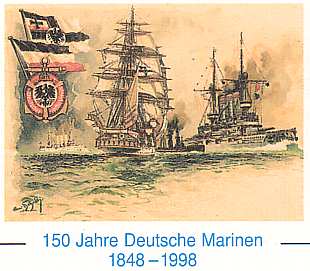
150 years German Navy
some stamps with German men of war.
|
|
German naval history starts on the 4th of June, 1848 in Paul's Cathedral, Frankfurt.
The first german national assembly assigned 6 million 'Thaler' for the construction
of a new, armoured fleet. The task was to defend the coastal water regions which
were threatened by the danish fleet. Denmark had left the 'German Union'
and started to blockade major german ports. In those days over 6800 merchant vessels
belonged to the German Union which were in dire need for protection..
|
|
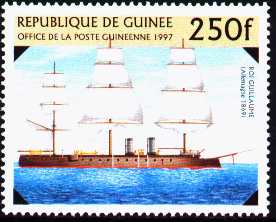
Captain Rudolf Bromme ( nickname 'Admiral Brommy') got the job.
During October 1848 the first fleet, consisting of several steam-frigates,
was ready to go.
On the stamp to the left you can see the 'Kaiser Wilhelm', built 1868.
|
A few small battles resulted in no great success and the war ended with
a peace treaty in 1850. The german parliament lost interest and the
ships were sold. The official end of the first german navy was
ordered in March 1853.
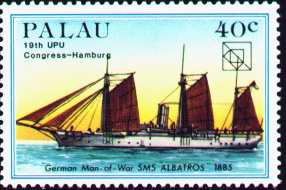
'SMS Albatros', 1885 (in those days Germany was a monarchy.)
|
|
|
| |
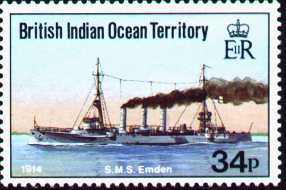
Light cruiser 'Emden', 1914. Cruiserwar in the Indian Ocean. After a fight with the
Australian 'Sydney' the 'Emden' was set agound off the Cocos Islands.
|
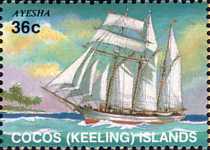
Sailing vessel 'Ayesha', capsized from the 'Emden' crew to sail from the Cocos Islands
to Sumatra.
|
|
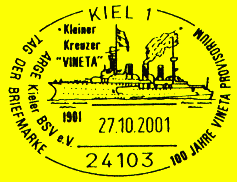
Light cruiser 'Vineta', built 1897, until 1905 in foreign service, then test and training vessel,
at least a dwell-ship at Kiel, 1920 broken up.
Well known in philately by the 'Vineta-Provisorium'.
There were no 3-Pfg stamps aboard, so they cut the 5-Pfg stamps in halves and marked them
with 3-Pfg. These letters were really transported.
|
|
| |
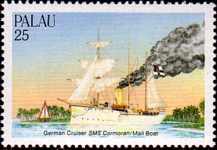
Light cruiser 'Cormoran', built 1892, on duty at East Africa, Southsea and at
Tsingtau as a gunboat. In 1914 exploded by herself at Tsingtau.
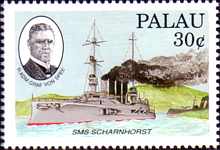
| Heavy cruiser 'Scharnhorst', built 1906, flagship of admiral Graf Spee
in the Coronel battle 1914. In the same year she sank at the Falkland battle.
|
|
| |
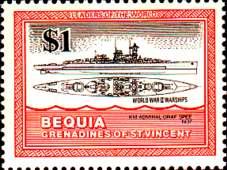
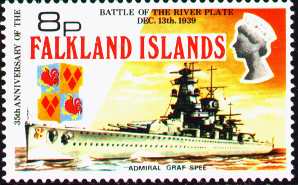
Dreadnought 'Admiral Graf Spee', 1936 in commission, 1939 war againt merchant ships in the
South-Atlantic. Battle of the River Plate against three British cruiser,
then entered port of Montevideo for repair. Blockade by the British cruisers. To save the
lives of the crew the ship was destroyed by herself.
|
|
| |
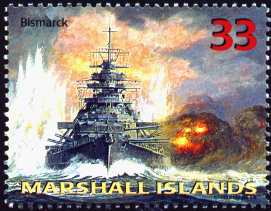
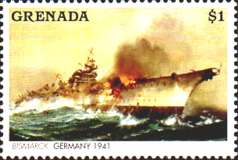
The battleship 'Bismarck' demonstrated the nonsense and the tragedy of war.
To the left she is displayed sinking the english battleship 'Hood'.
Some days later she was destroyed herself by enemy aircraft.
To the right the stamp shows the 'Bismarck' some hours before her sinking.
|
|
|
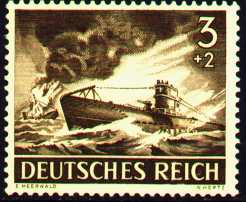
On the left the German World-War-II submarine type VIIA.
Altogether, German U-boats
sank 2,759 merchant ships and 148 men-of-war during World War II. Some
sources report 2,828 merchant vessels lost. Germany had built 1,162 boats of
which 784 became wartime casualties. Of the approximately 40,000 U-boat
sailors 28,000 lost their lives and some 5,000 became prisoners-of-war. No
other branch of military service had ever suffered such a high seventy
percent rate of casualties.
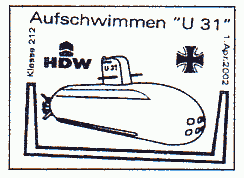
To the right you can see
'U-31' of the new German Navy, a submarine of the latest generation,
which was developed at the
Howaldt dockyard at Kiel, Germany. The engines of this type will work
independently from air.
|
|
|
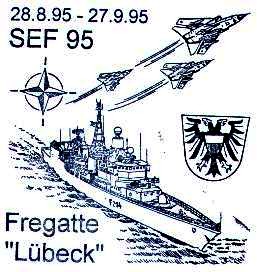
On the left postmark we see the frigate 'Lübeck' of the German navy.
The modern ballistic missile frigate came in commission in 1990 as the last of eight
frigates of the F122 (Bremen) type.
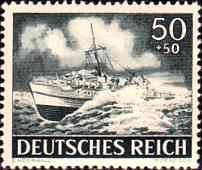
On the right we see a German torpedo speed boat of World War II. These boats were on duty in
the English Channel and the German Bight. They were able to run 40 knots.
|
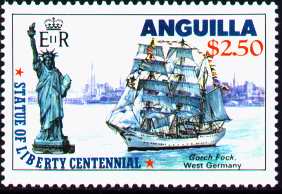
The 'Gorch Fock', Germany's ambassador of hope and peace.
All over the world this sailing-training-vessel of the German navy
demonstrates for friendship and comprehension between people and
countries.
Today the task of the newly created 'Bundesmarine' is not to win but
to prevent wars!
|
|
|